Mahama directs NADMO, State Engineers to organize a nationwide flood assessment.
Mahama directs NADMO, State Engineers to organize a nationwide flood assessment.

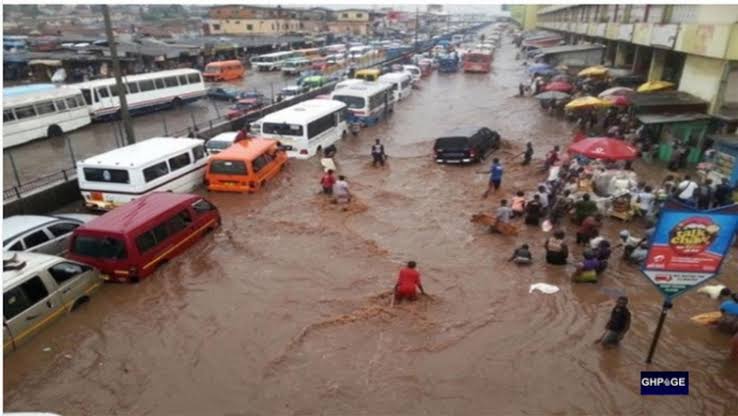
The severe flooding in Accra during early June 2026 has once again submerged major parts of Ghana’s capital.
Following heavy, persistent seasonal downpours, high-risk sectors have experienced massive transit disruptions, destroyed property, and structural collapses.
The ongoing rainy season has heavily disrupted transportation networks and residential areas. Some of the most severely impacted areas include: Kaneshie, Odawna, and Adabraka:
Roads turned into rivers, temporarily trapping residents and shutting down commercial markets. Kwame Nkrumah Circle enclave: Heavily waterlogged, severely paralyzing vehicle movements, and standard daily commuting.
Ashaiman Underbridge:
The key transportation link connecting Ashaiman to Sakumono and Adjei Kojo was partially submerged, causing massive traffic gridlock.
Oyarifa and Abokobi experienced rapid flash flooding and waterlogging along major road stretches.
In response to the early June crisis, President John Dramani Mahama issued an executive directive to the National Disaster Management Organisation (NADMO) and state engineers to organize a nationwide flood assessment.
This measure aims to map out blocked waterways and plan both immediate and long-term drainage modifications. Simultaneously, NADMO has activated regional emergency response centers to safely evacuate trapped individuals in low-lying zones.
Local government ministries have also renewed instructions for Metropolitan, Municipal, and District Assemblies (MMDAs) to bring down unauthorized buildings directly blocking natural waterways. Underlying Causes & Expert Outlook.
According to urban planning and engineering experts who have spoken, the 2026 flooding is a direct, predictable byproduct of unchecked urban development.
Main drivers highlighted include: Loss of natural drainage, replacing forest buffers and wetlands with paved surfaces and buildings, which prevents the earth from absorbing runoff water.
Again, existing concrete channels are choked with debris or are fundamentally too narrow to handle modern stormwater volumes.
The Ghana Meteorological Agency (GMet) has issued warnings indicating that enhanced, heavy rainy conditions will persist through June 2026, posing an immediate threat of further flash floods in Greater Accra’s low-lying areas.