FIFA re-activates the adage of “Robbing Peter to Pay Paul”… as it Robs Messi of His Adidas Golden Ball Award.
FIFA re-activates the adage of “Robbing Peter to Pay Paul”... as it Robs Messi of His Adidas Golden Ball Award.

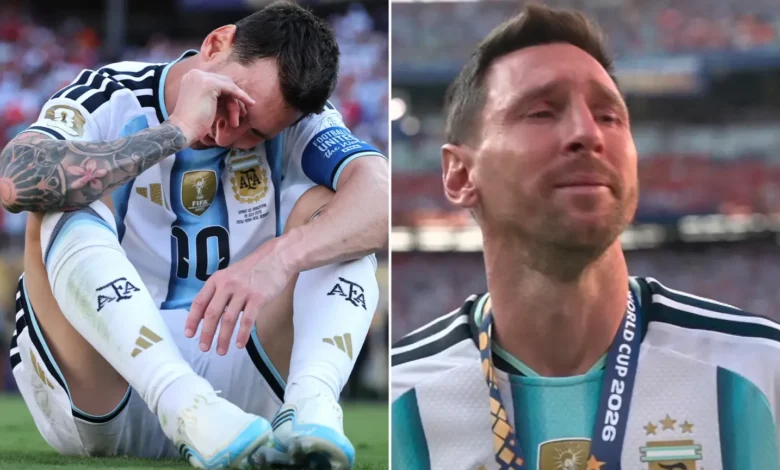


At the conclusion of the FIFA World Cup 2026 tournament, soccer’s global governing body has once again activated the old “robbing Peter to pay Paul” philosophy.
The ambiguity surrounding the technical tie-breaker rules and FIFA’s algorithmic leaderboard, has left millions of fans feeling that Lionel Messi was flatly robbed of his fairytale ending: the elusive 2026 Adidas Golden Boot. On the other hand, there are those who feel FiFA favoured Argentina throughout the tournament, however, fate simply did not have mercy on Messi

The Blistering Race in North America.
Messi rolled back the years. He formally retired from international football in June 2016 following a heartbreaking loss to Chile in the Copa América final. A massive fan campaign convinced him to rescind that decision months later. So, for someone who was on the verge of not ever playing for Argentina, he has staged a masterclass by netting eight goals and registered four assists across eight matches to carry Argentina all the way to the final.
It was a monumental feat for the 39-year-old icon, who also broke the record to become the all-time highest goal scorer in World Cup history. Yet, the ultimate individual crown eluded him due to the sheer structure of the tournament’s scheduling and technical regulations.

The Third-Place Play-Off Technicality:
The perceived “robbery” crystallized during the bronze-medal match, a fixture often criticized by purists as a mere exhibition game.
It was here that France’s Kylian Mbappé capitalized on a chaotic, wide-open 6-4 defeat to England. Seizing the defensive vulnerabilities of the third-place play-off, Mbappé struck twice, pulling away to finish the tournament with 10 goals.
This put Messi in an impossible position ahead of Sunday’s grand finale against Spain. Facing a defensively impenetrable Spanish side that had conceded only one goal through the entire tournament, Messi drew a blank in a grueling 1-0 extra-time defeat at MetLife Stadium.
Because FIFA calculates the Adidas Golden Boot solely on volume, using assists and minutes played as rigid tie-breakers, Mbappé walked away with the trophy for the second consecutive World Cup.
For Messi’s global fanbase, the structure felt fundamentally flawed: an award of such prestige was heavily tilted by a high-scoring third-place consolation match, effectively robbing a finalist who faced the toughest defensive unit in the world under maximum pressure.
Corporate Cleanliness Over Authentic Legacy.
To purists, this mathematical distribution feels like another bureaucratic corporate checklist. FIFA’s tie-breaker criteria ensure that sponsors like Adidas have a single, clearly defined commercial recipient, completely stripping away the human nuance of the sport.

Messi’s legacy remains entirely untouchable.
He steps away from the global stage with his status as the Greatest of All Time (THE GOAT) cemented by eight Ballon d’Or awards and the historic 2022 trophy.
However, the 2026 Golden Boot saga will forever linger as a stark reminder of modern sports administration: a system in which algorithmic parameters and fixture technicalities can easily eclipse the raw, emotional weight of a legendary campaign.
If you think Messi was unlucky, he’s far from the first great player to be denied the World Cup Golden Ball.
Great players like Ronaldo Luís Nazário de Lima (2002), Xavi Hernández (2010), Toni Kroos (2014), Antoine Griezmann (2018), and Lionel Messi (2026) have all been robbed of the World Cup Golden Boot before by the architecture of the global football governing body at one point in time.
…And if history tells us anything, this won’t be the last to divide opinion.