News & TrendingOpinion
From the Parliament to the Court:s: Srem-Sai v Srem-Sai and the Campaign Against the OSP
From the Parliament to the Court:s: Srem-Sai v Srem-Sai and the Campaign Against the OSP

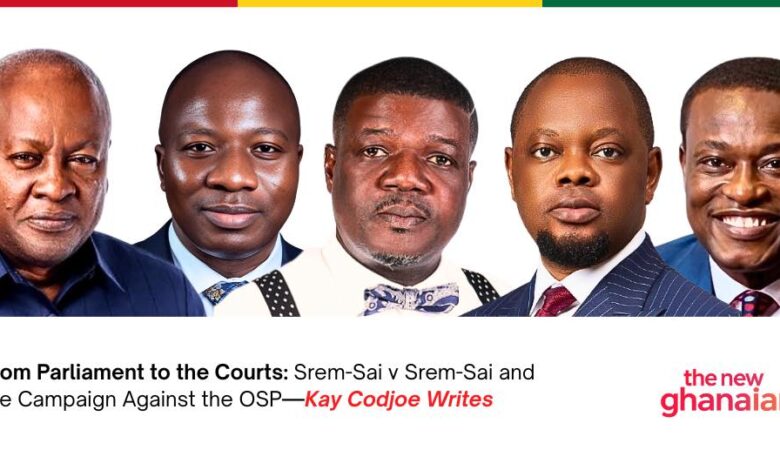
Ghana is watching something serious unfold, and it is no longer helpful to treat it as an abstract constitutional debate. The growing campaign to abolish the Office of the Special Prosecutor (OSP) is intentional. It is being driven by actors who resist an independent anti-corruption institution operating alongside a partisan-appointed Attorney-General, whose position inherently raises questions about prosecutorial independence.
It is worth recalling how this wave of anti-OSP agitation began recently. Public confidence was stirred when lawyer Martin Kpebu made grave allegations against the Special Prosecutor (SP) on national television. Those claims, though widely repeated, remain unsubstantiated, and unlike the three formal petitions already submitted, he filed no complaint for constitutional determination.
When invited by the OSP to clarify the allegations, he appeared but declined to cooperate. A later invitation led to an alleged altercation with security personnel and his subsequent arrest, detention, and bail. That incident intensified public debate, prompting calls for the abolition of the OSP or the removal of the SP, even though the allegations remain untested.
A key development in this growing campaign is the repeal Bill now circulating. It is a calculated attempt to reverse a major institutional reform, co-authored by the Majority Leader and the Majority Chief Whip. Their involvement signals that this is not an isolated idea but part of a coordinated political effort.
Majority Leader Mahama Ayariga has opposed the OSP Act from the start. He questioned its structure during the Martin Amidu era and has always preferred prosecutorial authority to remain with the Attorney General. It is also worth recalling that he was the first beneficiary of a nolle prosequi issued by Kissi Agyebeng in the tax exemption vehicle case. His sponsorship of a repeal Bill is therefore not surprising, though citizens are right to ask whether this renewed effort is principled or simply timely.
The Majority Chief Whip, Rockson-Nelson Dafeamekpor’s role raises a different concern. He has often presented himself as a defender of institutional independence, yet now supports a move that concentrates all prosecutorial power under one office. The shift invites reasonable questions about whether his position has changed or whether political calculation now carries more weight.
For a moment, the repeal momentum seemed to slow after President John Mahama, in a meeting with the National Peace Council, cautioned against abolishing the OSP. He described the calls as premature, saying, “We should give them a little time… people want to see more prosecutions and more results. I urge the OSP to speed up some of these investigations and show that the office is still very relevant.” Many assumed this marked the end of the push toward abolition.
But a new development emerged almost immediately. A lawsuit appeared before the Supreme Court seeking to achieve through litigation what the repeal Bill aims to accomplish through legislation. The plaintiff, Noah Ephraem Tetteh Adamtey, is a lawyer from Praetorium Solicitors, the private firm of the Deputy Attorney-General, Justice Srem-Sai. And it was the Deputy Attorney-General himself who broadcast the suit. A lawyer connected to the Deputy Attorney-General sues the Attorney-General. The Deputy Attorney-General amplifies the suit. The suit asks the Court to remove the OSP’s independence. And all of this unfolds as Parliament debates whether the office should exist. This is why many describe the matter informally as Srem-Sai v Srem-Sai.
This is not the first attempt to challenge the OSP’s constitutionality. Years ago, Ken Kuranchie asked the Supreme Court to declare the office unconstitutional. The Court dismissed his claim, affirming that Parliament acted within its authority and that Ghana needed an independent corruption-fighting body. That settled the matter until now.
The timing of this new suit is revealing. It arrives when the OSP is facing political pressure.
It arrives when petitions against the Special Prosecutor are before the Chief Justice. It arrives when the repeal Bill is circulating among policymakers. It arrives when some political actors are openly calling for abolition. Taken together, these events suggest a coordinated reconsideration of whether Ghana should retain an independent corruption prosecutor at all.
This raises two clear questions. Who benefits if the OSP loses its authority? And who bears the cost if Ghana returns to a system where all prosecutorial power rests within one political office? These questions go to the core of whether the nation wants accountability with some degree of independence or accountability entirely dependent on political structures.
Edudzi Tamakloe, the NDC’s Director of Legal Affairs and CEO of the NPA, has warned that the temptation to abolish the OSP is a trap the President should avoid, as it would hand the opposition propaganda capital. He argues the office should be strengthened, not dismantled.
Supporters of the repeal effort may present their case as a matter of efficiency or constitutional interpretation. But the practical outcome is unmistakable. If the OSP is abolished or stripped of independence, Ghana returns to a model where political actors determine which corruption cases proceed and which ones end quietly. It is a model that has historically struggled to deliver justice in matters involving political power.
There is also an assumption behind these manoeuvres. That the repeal Bill may progress without a strong public reaction. The Supreme Court challenge will be viewed as a technical matter. That civil society will move cautiously. That media attention will be limited. That the President’s reassurance alone will reduce scrutiny. These assumptions underestimate the seriousness with which citizens view institutional independence.
This is the moment for clear civic engagement. Civil society must examine the Repeal Bill carefully. CSOs must study the implications of the Supreme Court suit. They must articulate the consequences of concentrating all prosecutorial power under one authority. Silence or hesitation would leave the country exposed.
The OSP is not without its challenges, and its leadership and operations warrant structural reforms. But repealing is not reform. It is a reversal. And reversal would return Ghana to a prosecutorial system the public has long questioned.
Ghana is facing a choice. The choice to strengthen an independent accountability institution or to accept a return to a model that places all discretion in one office.
This is not the time to disengage. It is time to understand the proposals, examine the motives, and participate actively in shaping the country’s anti-corruption future.
Institutional accountability cannot be surrendered quietly. Not through procedural shifts. Not without full public justification. The greener the grass, the bigger the stakes.
By: Kay Codjoe